The 2025 IFLRY Freedom Award was granted to Sidi Touré, Vice President of Liberal International, Co-President of RenewPac, Minister of Animal and Fisheries Resources of Côte d’Ivoire, and a man complicit in democratic decay in Côte d’Ivoire. The award was a mistake, and IFLRY ought to correct it. Sidi Touré is a Minister in the Ouattara government, which weaponized legal systems to remove opposition candidates from the presidential ballot, illegally banned opposition protests, and arrested political youth leaders on dubious charges. Touré, rather than criticizing the government and speaking up for freedom and democracy, heaped praise onto President Ouattara and undermined international law. These events were widely reported on, meaning that the IFLRY Bureau could have easily found this information. Instead, they granted the Freedom Award to an antidemocratic government in the final days of their presidential election, granting them international legitimacy and hiding these injustices.
Ingestuurd door Maarten Tollenaar / An article sent in by Maarten Tollenaar
Ingestuurde artikelen vertegenwoordigen niet per se de mening van de DEMO of Jonge Democraten. Wil je reageren op dit stuk? Mail dan je reactie (naar redactiedemo@jongedemocraten.nl) / Articles sent in by external writers do not necessarily reflect the views of de DEMO or Jonge Democraten. Would you like to respond to this piece? Then email your response (to redactiedemo@jongedemocraten.nl)
The lead up to protests
Ouattara’s third or ‘second first’ term
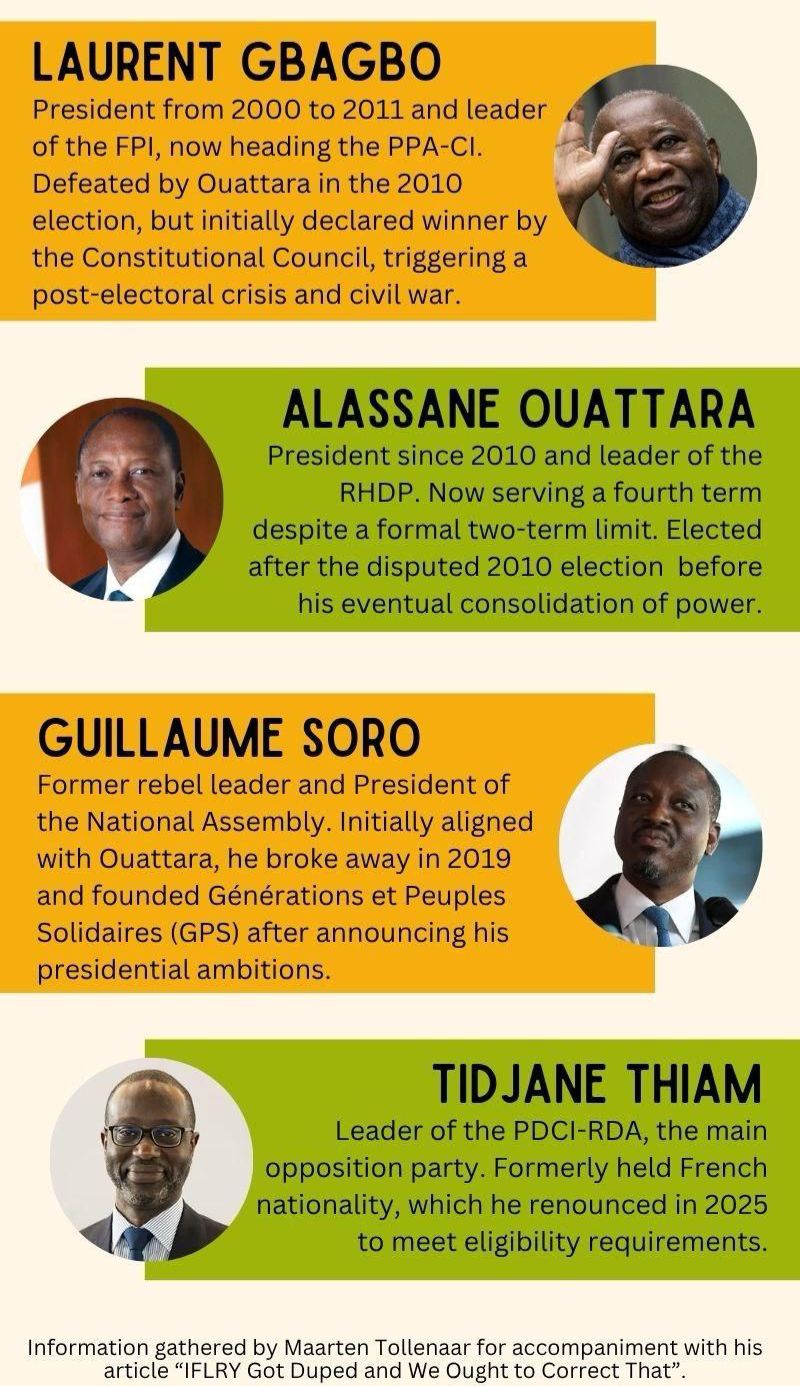
In 2020, Ivorian President Alassane Ouattara and leader of the Rassemblement des Houphouëtistes pour la Démocratie et la Paix (RHDP), decided to run for a 3rd term as president after having previously pledged he would not do so.[1] One would think that with the clear two-term limit in both the 2000 and 2016[2] Constitutions, he would be barred from running. However, the Constitutional Council, of which Ouattara personally selected a majority, decided that this was still allowed, since according to them the fact that a new Constitution was adapted in 2016 reset the term limits.[3]
This decision was characterized by a report from the Electoral Institute For Sustainable Democracy In Africa and the Carter Center as having “no clear or substantiated legal basis”. The report also called out the Constitutional Council disqualifying 40 of the 44 candidates for president.[4]
Soro ineligible as a candidate, in direct defiance of the African Court of Human and Peoples’ Rights
Guillaume Soro, former Ivorian Prime minister and President of the National Assembly, who had announced he too would run in the 2020 election, was one of those candidates that got disqualified. The Constitutional Council based this decision on the fact that Soro was removed from the electoral register because of a criminal conviction, the process for which was started after Soro announced his campaign for president, and was concluded in absentia. [5]
This was done in direct defiance of orders from the African Court of Human and Peoples’ Rights (AfCHPR) to let Soro run, telling Ivory Coast to remove any obstacles preventing the Applicant Guillaume Kigbafori Soro from enjoying his rights to vote and be elected. [6],[7] These orders are not merely suggestions, but legally binding on Ivory Coast.[8]
These orders by the AfCHPR to restore Soro’s democratic rights were dismissed by IFLRY Freedom Award recipient Sidi Touré as “serious and intolerable actions” when asked why Ivory Coast not only failed to comply but also withdrew the right of individuals and NGOs to bring future cases before the Court.[9]
Banning the leader of opposition from the presidential ballot
Fast forward 5 years to February 2025, and leader of the opposition Tidjane Thiam renounced his French citizenship to comply with the single-nationality requirement for presidential candidates. [10],[11],[12],[13]
On 22 April 2025, a court in Abidjan ordered his removal from the electoral register, rendering him ineligible to run.[14],[15] The ruling was based on doubts about his Ivorian nationality, given his acquisition of French nationality in 1987. [16],[17] The court dismissed key evidence, his father’s birth certificate, claiming that it was illegible. [18]
Thiam’s lawyers argued that he had French nationality from birth[19] and that the 1987 decree merely confirmed this, and further claimed the case was procedurally invalid. [20] However, there was no avenue for appeal. [21]
In apparent tension with the court’s ruling the Minister of Justice later stated that Thiam automatically regained his Ivorian nationality upon renouncing his French citizenship, [22] despite this mechanism not being provided for in Ivorian nationality law.[23] It should be stressed that this did not restore his place on the electoral register since the court had already removed him from the register.
Following this, Ivory Coast’s Bar Association issued a statement raising concerns about the electoral register, the Independent Electoral Commission (CEI), and reports of procedural violations in night-time arrests, warning that the rule of law was at risk:
Justice must not be a shadow theatre where power struggles are played out. It must remain the bulwark of freedoms and the guarantor of equality before the law.[24]
On 4 June 2025, the CEI published the final electoral register, excluding Thiam, Soro who was considering a candidacy[25], and Laurent Gbagbo who was running as the opposition party PPA-CI’s candidate[26].[27] [28]
In response, on 19 June, Thiam’s party, the PDCI-RDA, and Gbagbo’s PPA-CI formed the Front Commun[29], an alliance aimed at challenging the exclusion of opposition candidates.
On September 8th 2025, the Constitutional Council published the final list of candidates; neither Thiam nor Gbagbo were included. [30] The Council Council, a majority of whose members were appointed by the President, applied the same formalistic approach as in 2020, when it dismissed Soro’s candidacy, rejecting the candidacies of Thiam and Gbagbo on the basis that they were not on the electoral register. [31] This allowed it to dismiss objections from their respective parties, including challenges to Ouattara’s eligibility, without addressing the merits. [32]
This asymmetry is not incidental, but indicative of a broader pattern. When assessing opposition candidates, the Constitutional Council applies strict formalism, invoking procedural grounds to exclude them while disregarding binding international law. In contrast, when questions concern President Ouattara, the person who appointed a majority of its members, that formalism dissolves into a far more elastic and accommodating interpretation of the law.
Suppression of dissent
Banning of peaceful protests
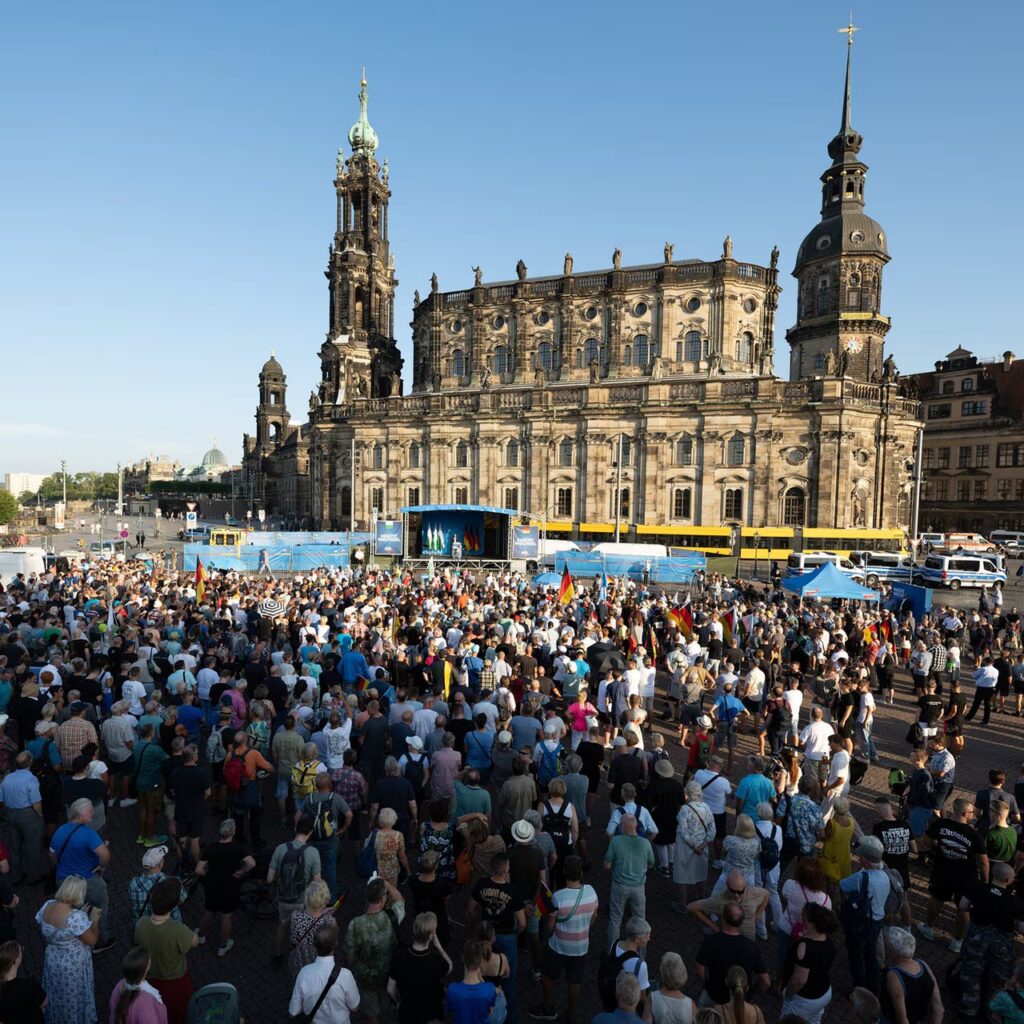
In response the Front Commun, announced a peaceful march for 4 October[33], in line with an earlier large and peaceful protest on 9 August against the exclusion of candidates, a fourth Ouattara term, and the composition of the CEI, whose impartiality has also been contested[34]. [35],[36]
Two days before the planned protest, the National Security Council, Chaired by President Ouattara[37] declared that “any contestation, of whatever nature[38], of the decision of the Constitutional Council is illegal” and ordered measures including bans on demonstrations; authorities subsequently prohibited the march, abstractly claiming ‘high risks of disturbance to public order during this presidential election period’, even though the aforementioned August 9th protest was perfectly peaceful, which was acknowledged even by the state-aligned newspaper Fraternité Matin, which described it as an “impressive mobilisation for democracy”[39].[40],[41]
The IFLRY bureau made the decision to give the Freedom Award to Sidi Touré on October 10th, when all of this information was available and easily found with a quick Google search.
Although the Front Commun initially complied, new protests were called for 11 October[42]. At these protests security forces dispersed crowds with tear gas[43] and carried out mass arrests, over 700 in total, with at least 50 later sentenced to three years in prison. [44] Amnesty International reported that protesters were peaceful and that arrests were made without disclosed charges. [45]
Then, on October 17th, in a further escalation of its repression of public discourse the Ouattara government explicitly banned all public manifestations that were not part of the presidential election, therefore banning any protest in relation to candidates who were barred from running.[46]
The very next day, IFLRY hands over the Freedom Award to Sidi Touré, a minister in that same government and vocal supporter of Ouattara.
A week later, on the 25th of October, Ouatarra wins the election with 90% of the 4,292,474 votes cast, on a population of around 30 million[47].
Six days thereafter, on the 31st of October, Sidi Touré praised this ‘resounding electoral victory’ in a news message from Liberal International, which of course made no mention of the myriad of anti-democratic and illiberal actions taken by the Ouattara government in this election.[48]It is important to note that this blanket banning of protests was not just illiberal and anti-democratic, but also illegal under Article 21 of the International Covenant on Civil and Political Rights[49] and Article 11 of the African Charter on Human and Peoples’ Rights[50], both of which are binding on Ivory Coast.
Political arrests
Earlier that summer, on June 4th 2025, police summons were issued for Innocent Yao, leader of the rural youth of the PDCI-RDA, the main opposition party led by Tidjane Thiam. A complaint was filed against him for making a video in which minors are seen wearing political party t-shirts; when he appeared, he was instead charged with terrorism-related offences[51] and placed in pre-trial detention. [52] Four other PDCI-RDA youth leaders were detained for “disturbing public order” after calling for mobilization ahead of a rally in support of Thiam. [53],[54]
Another youth leader, Jonathan Glalou Boris Sohou, claims he escaped an attempted abduction in Agboville on 8 July by men wearing hoods[55], which seems to be another attempt of what had the Ivorian bar association concerned: night-time arrests carried out in violation of procedural rules.[56] The public prosecutor’s office refused to comment on any of this when asked by Le Monde.[57]
Repression extended beyond youth activists. Former human rights minister Joël N’Guessan was arrested on 18 June for criticising candidate exclusions, while rights advocate Gervais Boga Sako fled after being summoned by police. [58]
While the Ouattara government denies that they were involved in any of this, le Monde claims to have a source close to the authorities who anonymously stated: “We were taken by surprise in 2020 by the PDCI and other opposition parties who had planned an insurrectionary situation. That will not happen this time. Freedom of expression is guaranteed and so is firmness.” [59]In that same article, Amnesty International executive director for Côte d’Ivoire Hervé Delmas Kokou characterises this as ‘recurring repression of dissenting voices’[60].
Looking at the whole picture
In a 13 May Financial Times letter, Francis Fukuyama, Paul Collier and others warned that the law in Côte d’Ivoire is being applied selectively to exclude a viable opposition candidate whose success would threaten an entrenched ruling group. [61] The government, through Communications Minister Amadou Coulibaly, dismissed this as disinformation, insisting it was merely enforcing court decisions. [62]
This exchange captures the broader pattern. Any one of the events I have described above, viewed individually, might be viewed as an unfortunate, but not intrinsically antidemocratic, over correction from a state that is still traumatized by two recent civil wars; taken together, they point to a systematic effort to exclude meaningful opposition and suppress dissent through state power.
Legal justifications are invoked to repress opposition, through terrorism charges or court rulings, yet binding decisions of the African Court of Human and Peoples’ Rights are ignored, and access to that court has been curtailed, while rights to peaceful assembly and political participation under international law are similarly disregarded. At the same time, the Constitutional Council applies strict formalism to bar opposition candidates while adopting incredibly creative positions to permit Ouattara’s continued rule.
This is the type of behaviour that corrupts and perverts the rule of law, which is intended to hold all those under its jurisdiction to the same standard and protect all of under its wings into its polar opposite: oppression and exclusion, while wearing the carcass of legality to attempt to mask what it has become
Sidi Touré’s Complicity
Sidi Touré does not play a starring role in the bulk of this article, but he is nevertheless complicit in the misdeeds that we will discuss.
Sidi Touré is not just Minister of Animal and Fisheries Resources of Côte d’Ivoire; he might very well be President Ouattara’s most loyal supporter. Not only has he written two books about the man[63][64], he was a campaign spokesperson for the Ouatarra campaign[65] and takes every single opportunity he can to publicly champion his boss, as was clearly visible through his nearly-daily praise[66] of Ouattara during the campaign, ignoring the concurrent suppression of democracy. Touré’s big political break was being appointed Ouattara’s chief of staff in 2006, a position he kept until he was made minister in 2015, after which Ouattara has appointed him to multiple positions of minister[67][68].
If the connection wasn’t clear enough, Touré even went so far as to dedicate the IFLRY Freedom Award to President Ouatarra, publicly tying IFLRY’s award to support for the government.[69]
Never too Late to Right a Wrong
We have given our Freedom Award to a man who is part of a government that is consistently antidemocratic, and we have done so during an election that saw incredibly illiberal and illegal suppressions of the opposition by that government, including the unsound arrests of political youth leaders.
Touré took no opportunity to speak out against these injustices. He called lawful orders from an international court “intolerable” [70], despite those orders merely requiring the authorities to cease the suppression of an opposition candidate and used this claim to justify removing Ivorians’ access to the African Court on Human and Peoples’ Rights.
All of that is in direct opposition to our fundamental ideals as stated in the IFLRY Manifesto.[71]
None of this came as a surprise. Most of this misconduct, starting in 2020, took place and was widely reported on. At the very same time as the IFLRY Bureau was considering Touré for the Freedom Award, the Ouattara government’s ban on opposition protests was getting heat in international media, a negative narrative the government used IFLRY and Liberal International to neutralize. Nearly all of these illiberal incidents took place before the Bureau made their decision public.
In giving him this award, we have enabled Sidi Touré to grant some degree of legitimacy to his government, which for the actions discussed in this article has come under international scrutiny. Similarly Liberal International, where he is in the Bureau, simply celebrated the electoral victory of Ouatarra with a big statement from Touré and without a single peep of criticism helps to wash this government’s hands of the antidemocratic actions in the waters of its naive international support.
IFLRY should rectify this grave mistake, and the Liberal International Member Organisations should really consider the full background of Sidi Touré should he run for reelection.
Foto: Maarten Tollenaar